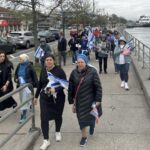
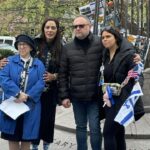
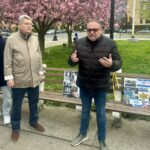
Under a chilly spring sky, dozens gathered on Sunday morning, April 19th, at Holocaust Memorial Park, at West End Avenue in Sheepshead Bay, for the annual “March of the Living: Walk to Remember,” a solemn and powerful tribute marking Yom HaShoah (Holocaust Remembrance Day). Participants, wrapped in blue and white, many carrying Israeli and American flags, came from across Brooklyn and beyond to honor the memory of the six million Jews and five million others murdered by the Nazi regime.
The ceremony opened with brief but moving remarks from community leaders and elected officials, including Assemblymen Michael Novakhov and Alec Brook-Krasny, people of different faiths, clergy and local advocates. Holocaust survivors — among the last living witnesses to history’s darkest chapter — stood as both symbols of resilience and reminders of the urgency to preserve memory for future generations.
Candles were lit. Stones were placed — each representing not only remembrance, but roots, heritage and the countries from which families once came. The crowd walked together along the waterfront, a living tribute to those who no longer can.
“We must never forget what happened to so many innocent people,” Novakhov said. “And we must stand strong in ensuring ‘Never Again’ truly means never again.”
Organizers and participants alike extended heartfelt gratitude to the many individuals who helped make the day both meaningful and secure. Special thanks were given to the 61st Precinct, for maintaining a strong and reassuring presence throughout the event, and to D’Anna Andrea for coordinating with the NYPD. Clergy who offered words of reflection included Rabbi Baruch Binyamin Melman and Rabbi Shlomo Segal, while Novakhov and Brook-Krasny had words of remembrance and resolve. Stephanie Benshimol, a dedicated Jewish community advocate, brought flags, pins, stickers and signs that represent the cause.
Ariel Rebecca served as emcee. Rebecca’s role carried added significance for many in attendance. She previously led Sheepshead Bay’s “Run for Your Lives” walks — weekly gatherings held every Sunday, rain or shine, in solidarity with the hostages taken during the October 7 attacks in Israel. Those walks became a symbol of endurance, unity and unwavering advocacy, continuing until all hostages, living and deceased, were returned home. While that chapter has now closed, the spirit behind it remains deeply connected to events like the March of the Living.
This year’s gathering carried added weight. As time passes, this will be the last generation where Holocaust survivors will remain to tell their stories firsthand. That reality lent urgency to the day’s message: remembrance is no longer just about honoring the past but also safeguarding the future.
As speakers emphasized, the fight against antisemitism did not end with history, nor with any single moment of crisis. With Holocaust survivors still among us — but fewer each year — a profound responsibility to remember, to teach and to ensure that “Never Again” endures not as a slogan, but as a solemn and unbreakable covenant.
Yet even as the echoes of the March of the Living lingered, a stark contrast unfolded the very next day. The community came together, once again, against the invaders who come to quiet neighborhoods to instill fear and intimidation.
On Monday, April 20th, a pro-Hamas protest with masked agitators organized by Al-Awda targeted Mini-Circuits, a family-owned business operating on Neptune Avenue since 1968. Demonstrators, citing alleged ties to Israel, claiming they produce military parts for the IDF stood outside the building. They then marched toward Brighton Beach with Palestinian flags, while local counter-protesters gathered with Israeli and American flags, viewing the action as intimidation against a longstanding neighborhood establishment.
Speaking from Albany, Novakhov condemned the demonstration, stating, “This is not a protest. This is bullying. This is antisemitism at its finest,” also affirming that the community “will not be silent” and “will stand against hate every time.”
The sharp contrast between the solemn Holocaust remembrance and the confrontation the next day underscored a deeper reality for many residents: that the lessons of history remain urgent and the commitment to stand against hate and antisemitism continue in the present day.