
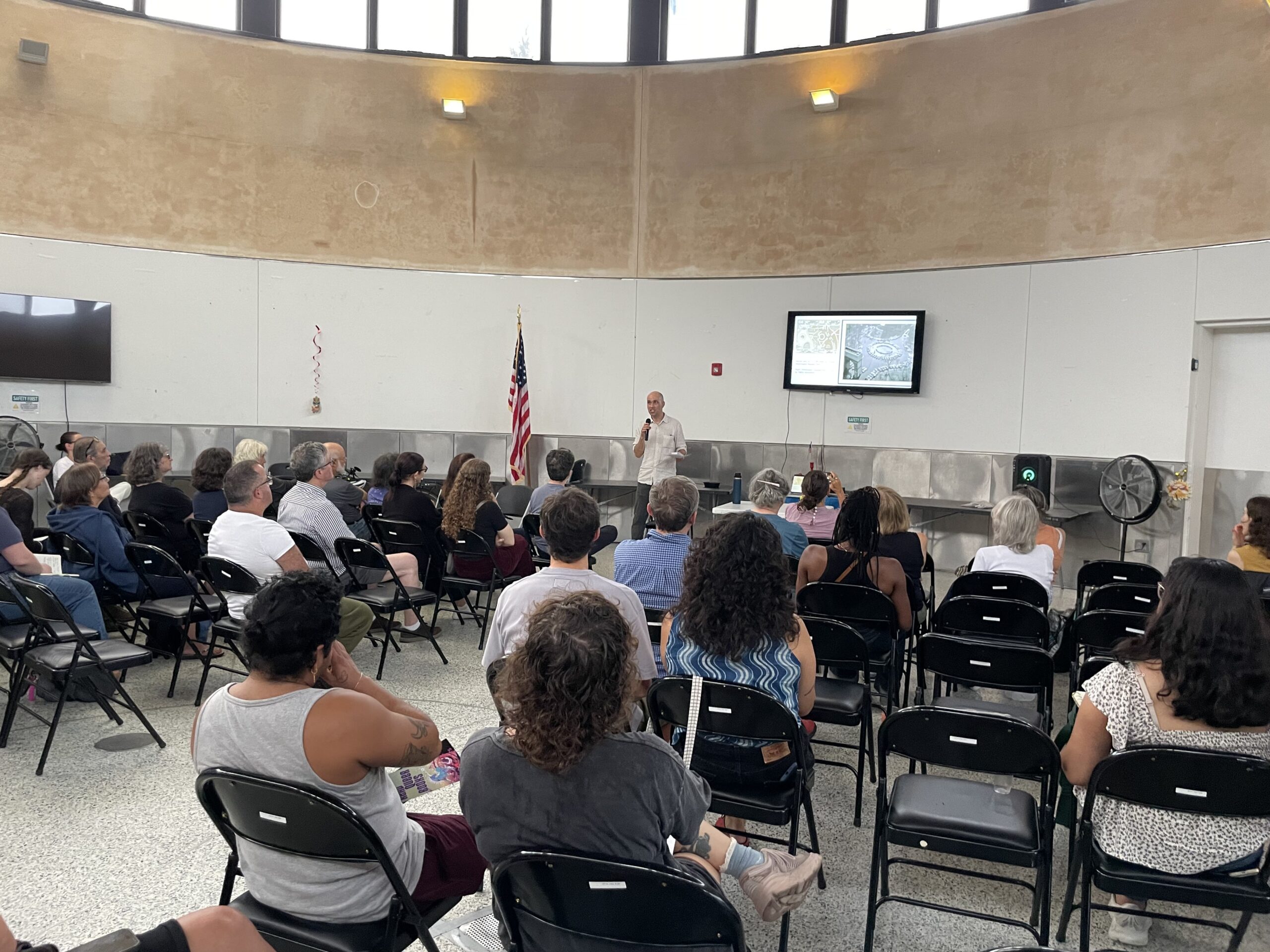
Attendees gathered on Tuesday, August 11th, at the Carmine Carro Community Center, 3000 Fillmore Avenue, for a lecture on New York writer, activist and urban theorist Jane Jacobs, whose work has had a massive impact on today’s urban landscapes and their social and political climate.
Organized by the Brooklyn Public Library and the Brooklyn Institute for Social Research with assistance from the Marine Park Alliance, the lecture, “Jane Jacobs, Greenwich Village and the Life of the City,” is part of a series titled Sips and Scholars, which are free lectures held in public spaces such as local parks, gardens and bars across Brooklyn throughout the summer.
Curated by Dr. Andy Battle, the lecture brought to light who Jacobs was and why she mattered as a New York figure, focusing on her life, lifestyle and philosophy.
Born in Scranton, Pennsylvania, in 1916, Jacobs moved to New York City during the Great Depression, initially living in Brooklyn before taking a liking to Manhattan’s Greenwich Village and settling there. Jacobs was a writer by profession, and she focused on architecture and the urban landscape, where she shaped her philosophy and her activism.
Battle argued that Jacobs’ philosophy opposed Robert Moses’. Where Moses wanted to redesign New York from the ground up, demolishing old neighborhoods while building expressways and highways, Jacobs focused on the “local” aspect. Jacobs’ philosophy was to keep older residential districts, particularly “mixed-use developments,” where residential, commercial and retail spaces are together rather than separate and far apart. Jacobs advocated for policies that included keeping the new from replacing the old, and instead integrating with it, and her idea of “eyes on the street,” where locals contribute to their own safety rather than relying on police or external security.
Battle discussed Jacobs’ magnum opus, The Death and Life of Great American Cities, which delves into her ideas, critiquing at the time urban renewal policies and top-down city planning and espousing her ideals that mixed-use zoning, small blocks, historic architecture and higher-density populations are necessary for higher living standards in cities.
Her activism helped prevent Moses from constructing a four-lane highway through Washington Square Park, stopped the construction of the Lower Manhattan Expressway, and, later, while living in Toronto, the Spadina Expressway.
Her legacy continues today, as every year during the first weekend of May, a “festival of free, community-led walking conversations” is held worldwide. The Canarsie Courier covered the 2nd Annual Jane’s Walk, led by Canarsie Historical Society President Ira M. Kluger (see “Canarsie Walking Tour Brings Local History to Life,” Canarsie Courier, May 14, 2026), where attendees learned about the history of Conklin Avenue, once a bustling business corridor, including a stop at the Canarsie Courier office.
“Jacob’s language and her ideas have really given us our own language and ideas for thinking about ‘What is good, what is valuable, what’s possible in the cities, and what do we love about them and what we love about living with one another in a place like New York City,'” Battle said. “Jacobs was someone who dedicated herself to trying to figure out what that was and also to try to create the conditions where it could grow. I think that’s why she’s important.”
Brian, the contrast between Jacobs’s neighborhood-scale thinking and Moses’s top-down rebuilding makes her influence feel especially tangible. Connecting “eyes on the street” to the community-led walks also shows how her ideas moved beyond planning theory and into the way New Yorkers understand their blocks.